305-304. ogre battle + the fairy feller’s master stroke

“I definitely prefer Queen‘s earlier more obscure stuff. Bohemian Rhapsody for instance is just not as rocking, as imaginative, as deliriously wigged out, as good, as the two tracks (joined as one) that that kick off side two (Side Black) of their second album (the imaginatively titled Queen II). Ogre Battle hits first, rocking like something out of a thrash metal wet dream, and featuring actual ogres battling in and around a two-way mirror mountain, with smoke and explosions. And then comes The Faerie Feller’s Master Stroke, better than the opera part of Boho-Rap because it’s not just some multi-tracked excuse for the band to show off their vocal talents, it’s actually about something, it’s about a painting from the 19th Century that Freddy Mercury could not get enough of, by a guy named Richard Dadd — ten years in the making, and all of them spent by Mr. Dadd in an insane asylum where he was serving a life sentence for murdering his dad. It’s true.” (Philip Random)

Queen-1974

306. the temple

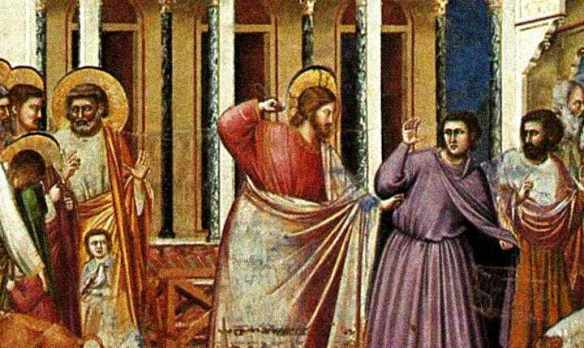
In which Jesus loses his cool when he discovers the sacred temple of Jerusalem has been taken over by the moneychangers, goes all punk rock on things. But seriously, when this Original London Cast recording gets to humming (not to be confused with the okay-but-just-not-as-good movie soundtrack), it’s as cool as funky as rockin as any dozen satanic offerings. Of course, it helps having Deep Purple’s soon-to-be front man Ian Gillan playing the title role, leaving no sonic scenery un-chewed.

Jesus+moneyChangers

307. if I can dream

“When Elvis (aka The King) died in 1977, John Lennon was smugly heard to observe that he’d already been been dead for almost twenty years — ever since he joined the army back in 1958. But I give him another ten years, to 1968 and the big deal comeback TV special on NBC.  Martin Luther King and Bobby Kennedy had just been shot, the Vietnam war had officially gone to hell, the Beatles hadn’t played live for years. But Elvis wasn’t worried.  He had a secret weapon for the show’s finale, a brand new song written by a guy named Earl Brown called If I Can Dream. ‘I’m never going to sing another song I don’t believe in,’ said Elvis when he first heard it, ‘I’m never going to make another movie I don’t believe in.’ And yeah, Elvis did deliver on NBC, a performance that reached deep through the strange vacuum of the cathode ray tube and touched the hopeful soul of all humanity, maybe even saved the world. But then he proceeded to eat doughnuts, sing awful songs, make worse movies, and finally died nine years later, alone, sitting on a toilet. Poor guy. The King of Need, the Residents called him.” (Philip Random)

Elvis-1968-smokin

308. crazy baldheads

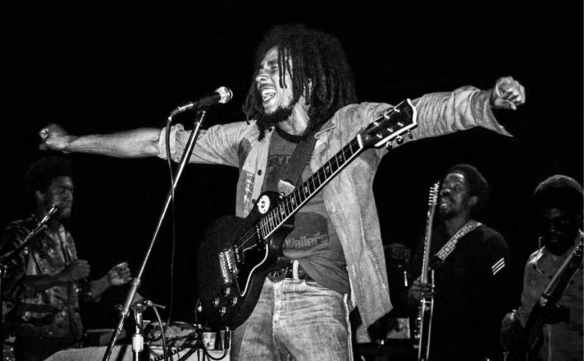
“I believe that’s us Bob Marley is howling about here, our dads and granddads and uncles anyway – the crazy baldhead agents of colonial Babylon doing the devil’s work, making a mess of every beautiful thing in creation. Found on 1976’s Rastaman Vibration, the first Marley and the Wailers album to crack the American top ten. The times were a-changing. And you could dance to it.” (Philip Random)

BobMarley-1976-live

309. wall of death

“Yes as a matter of fact, folk music did still matter in the 1980s, certainly in the hands of Richard (and sometimes Linda) Thompson. Because you just can’t argue with a song like Wall of Death, with pushing harder, faster, to the edge and beyond, working your momentum up until gravity’s no longer your master, just a thing to be played with straight up the wall of death (an amusement park thing in Britain, riding a motor vehicle in a circular pit until you get up enough momentum to defy gravity, pull stunts, get the crowd to roaring). Gravity will win in the end, of course, but that’s life, isn’t it?  Not defined by where you end up, but all the crazy beautiful moves you pulled en route and the places they got you.” (Philip Random)

Richard+LindaThompson-1983

310. talk about the passion

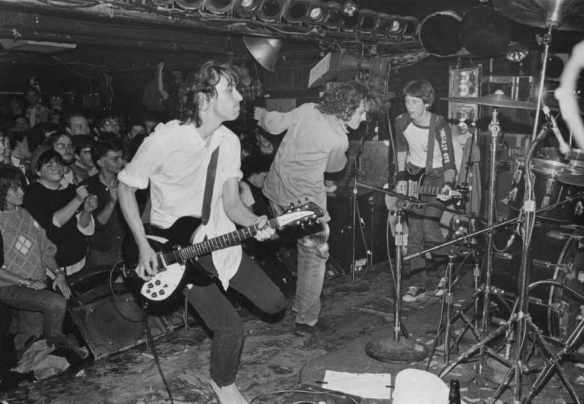
“It’s hard to overstate how big a deal REM were in the cool world when they first hit, except maybe to say, everything about them was punk … except their sound. They did it their way, Michael Stipe resplendently inarticulate, the other guys jangling along with deceptive power, reminding us that there was way more to music than all the godawful corporate radio crap we hated and and/or punk’s necessary vomit. Which was the key, I guess. So much beautiful and mysterious stuff between those extremes that wanted exploring. All that passion. And yet, I don’t think REM ever really topped that first album, Murmur. They’d never be that essential again, even as their sound got sharper, tighter, and Mr. Stipe stooped to enunciating, even making sense eventually. Which wasn’t necessarily what anyone had been asking for.” (Philip Random)

REM-1983-live