68. halo of flies

“The fourth Alice Cooper album, the one known as Killer, is as fine a slice of epic rock spectacle as the early 1970s delivered, and they delivered a lot. I distinctly remember the first time I heard it, at my friend Malcolm’s, who immediately went out and bought it when the news hit about a kid a few suburbs over who’d hung himself trying to imitate the ‘hanging trick’ pictured on the calendar found inside. The newspapers were all over it for a while. Fourteen year old boy kills himself because of Alice Cooper. Which, of course, is as deep as any adult ever went when it came to Alice. The pictures. Their loss, because there was nothing shallow about the music. Creepy, dynamic, erupting with grotesque passion and cool … particularly Halo of Flies. Apparently, it’s about espionage. Halo of Flies being an evil outfit working deep networks of counter-intelligence-terrorism-revenge-extortion-perversion, and thus they must be smashed. And our man Alice and his crowd of weirdoes are up to the task, whatever it takes, even a little Rogers + Hammerstein if needs be. Would’ve made a helluva movie.” (Philip Random)

69. in my time of dying

“Because the highest Led Zeppelin track on this list would have to be from Physical Graffiti, the best of their least overexposed albums. I mean, I never even heard In My Time Of Dying until I finally bought Physical Graffiti, summertime 1989, almost fifteen years after the fact – that fateful day I went to the record store intending to spend a hundred bucks on maybe seven CDs and instead walked out with better part of thirty used albums, plus a pile of 7-inches. Because everybody was suddenly doing what I’d thought I was doing: switching to CDs. Which meant they were dumping all their vinyl. Which meant here was pretty much every album I’d always wanted but couldn’t really afford, now being  pretty much given away. And when I got home, Physical Graffiti was the first thing I played, with In My Time Of Dying EVERYTHING that had ever made Led Zeppelin legendary. The blues, the ROCK, the epic and dynamic darkness that said as much about the hard times of the Mississippi Delta circa 1932 as the concert trails of 1974. Or the imminent end of the world circa 1989, for that matter — one’s time of dying never more than a heartbeat or a split atom away.” (Philip Random)

(image source)

70. the world is a ghetto

“Because it’s true, what the title says, the world is a ghetto, and never more so, it seems, than 1972-73, when I was finally getting serious about music, exploring the FM radio waves (which were still infinitely cool then, still dominated by DJs who loved music playing the stuff they loved). And that meant the extra long album version of The World Is A Ghetto got a lot of play, the version that really took you therewalkin down the street, smoggy-eyed, looking at the sky, starry-eyed, searchin’ for the place, weary-eyed, the fires of the 1960s riots and insurrections still smouldering, the smoke reaching even the whitebread suburbs of the Pacific Northwest where we didn’t really have so-called Black people. Yet we had their music and thus some small piece of their truth, I guess. Which, in the case of the band known as War meant all manner of genres, influences, ethnicities, impressions. They even had a white guy from Denmark playing some very haunted harmonica. Because this music wasn’t of or about any one place. It really was the whole world.” (Philip Random)

71. third uncle

There is absolutely nothing wrong with Brian Eno’s original take on Third Uncle. Bauhaus’s cover is just louder, fiercer, more dangerous, better. In fact, it gets downright harrowing before it’s done – a reminder that so-called Goth didn’t even exist at the time, Bauhaus being one of those rare outfits that forces a re-think, a whole new definition. Yeah, there were already lots of folks dressing in black, mourning for their own deaths, but they were just part of the greater scene, lurking in the shadows of the cooler clubs like something important was being born, but it hadn’t quite arrived yet. Until along came Bauhaus, looking good in black themselves, and way too loud to ignore.

72. mongoloid

Mongoloid rates high indeed because it’s the first punk tune that ever truly grabbed me, even if some have argued (and no doubt continue to) that Devo weren’t Punk, they were New Wave, to which I just fire back a big WHATEVER. It would’ve been 1978 because Tormato, the latest Yes magnum opus, had been released, except it was neither magnum or opus. But I loved it anyway being a fan. But not my friend Carl, who made a point of removing Tormato from the turntable mid-song (the one about a UFO as I recall) and slapping down Devo’s first album in its place … which proceeded to make an impression. Particularly Mongoloid. Just the whole nasty punk idea of it – a wound up anthem about some guy who was a mongoloid. How perverse was that! And yet fun. Because it was. Unlike the Yes. But Yes weren’t aiming for fun, I tried to argue, they were fixed on something more complex, important. Carl just smiled and played Mongoloid again. By the third time through, I was air-guitaring.” (Philip Random)

(image source)

73. hyperbolicsyllabic – sesquedalymistic

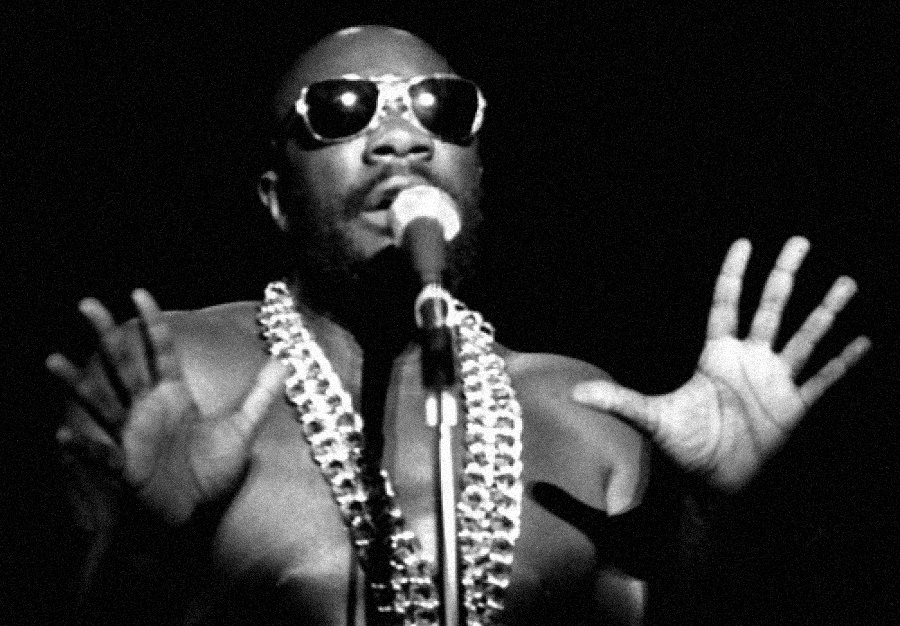
“I’m guessing the title is sort of a nod to the Mary Poppins tune, though the song itself takes off in a more resolutely soulful direction. And cool it is until the groove takes over and things genuinely elevate care of  the kind of musical genius that isn’t afraid to just let the piano speak, give it all the space it needs, don’t worry, it won’t disappoint you. Isaac Hayes (yeah, you may know him better as Chef) being the genius in question, the groove itself being so hot that Public Enemy would put it to stunning use a couple decades later in Black Steel In The Hour Of Chaos (one of their greatest moments) … almost as if Mr. Hayes had it planned all along. And maybe he did.” (Philip Random)

(photo: Chuck Dees)