17. feurio

Speaking of making the best of the hand that God or the universe or just overall randomness has dealt you, no list of top twenty records that most people probably haven’t heard would be complete without something dire and eviscerating from the Berlin outfit known as Einsturzende Neubauten. With Feurio (from 1989’s Haus Der Luge) getting the nod here because it is 1989, the year The Wall came down, the year everything finally gave. Not that the Einsturzende crew knew what was coming while they were recording the album. It was just heads down, eyes wide open industrial strength soul music, because when the enemy’s been at the gates your whole life, that’s what you do – you give everything, leave no energy un-realized, no noise un-made.

And nobody’s ever had enemies at their gates like everyday Berliners of the Cold War world (1945-1989). Hard not to be bleeding sparks from the friction of everyday life when you’re sandwiched between the world’s two great military powers, flexing their military and ideological bullshit for four and a half decades. So we get this fierce and timeless force of nature. Feurio translating as Fire — by pressure and body warmth / will our confusion become a nuclear fusion / and enormous / enormous / amounts of energy will be released. Which is exactly what it sounds like — the furious heat of souls that won’t bow down, that won’t submit to all the usual political economical bullshit. Or as Neil Young commented at around the same time.  Keep On Rockin In The Free World, except Berlin was neither free nor un-free. It was the line between. Lest we forget.

19. starless

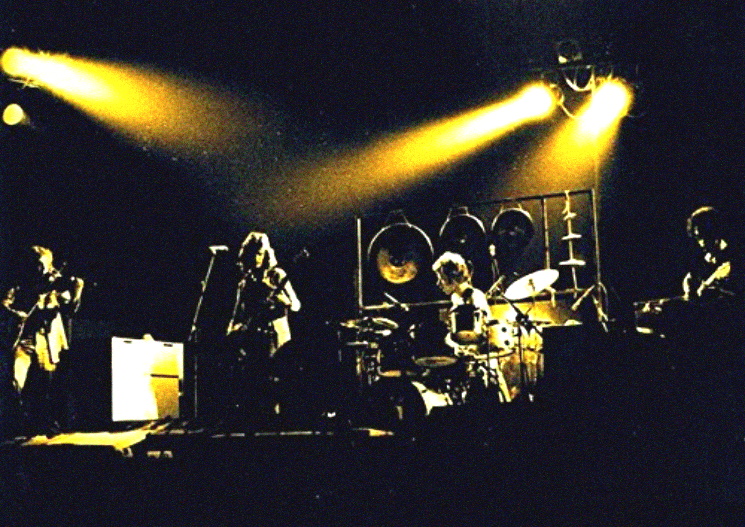
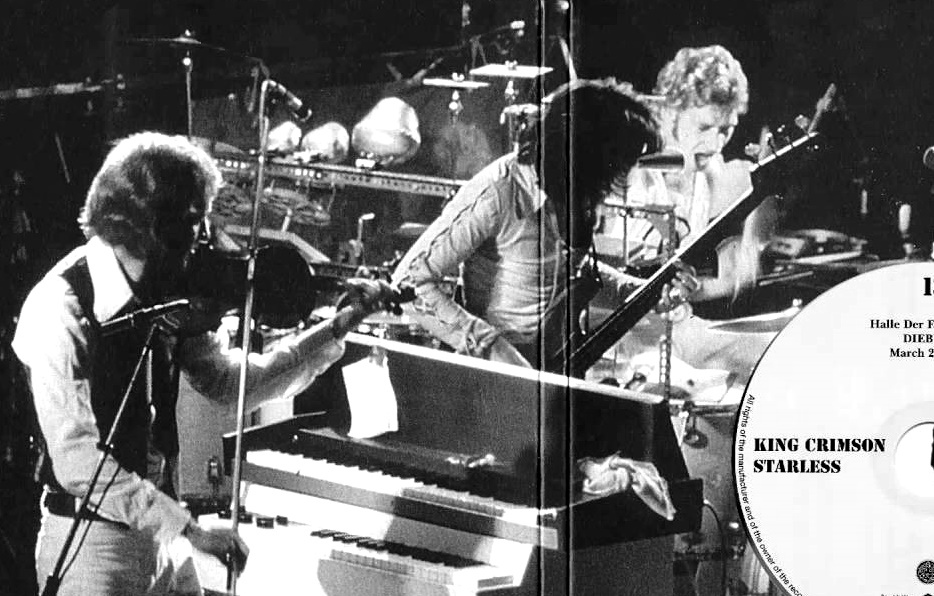
Starless is just a lament basically, though for what I’m not sure. Maybe a lost love. Or perhaps every apocalyptic thing, because by the time it’s done, it’s pretty much fractured the universe, having done that thing that I’m pretty sure only so-called progressive rock can do (or certainly King Crimson, who it’s pretty easy to argue, invented the genre). Which is to say, Starless doesn’t waste a second of its twelve and half minutes, but neither is it ever in a rush, the first four minutes or so serving as set up (the aforementioned lament), the final eight evoking first the darkest night there’s ever been, and then … well, words fail. But the music doesn’t. The music carves a hole straight through all that darkness, ultimately unleashing vast Niagras of tumultuous and redemptive light. It’s unearthly, it’s uncanny, it’s terrifying, it’s finally so f***ing beautiful you want the whole of creation to just … well, I said it already, words fail when you go that far beyond the perimeter …

The weird part is that the guy singing is John Wetton who would go on to front Asia (the band), which, I’m sorry, is the kind of transgression that can only lead to eternal hellfire. Except based on Starless, maybe he’d already been there. To hell, that is. Which gets us to my old friend Geoffrey (aka the philosopher), and his three essentials of any epic. 1. There must be a hero. 2. There must be a list. 3. There must be a descent into hell. I’m still trying to figure out the list part, unless that’s what I’m doing here. But I’m no hero and I’ve only ever been half-way to hell. Anyway, I guess we’re supposed to be left with a mystery, certainly in the case of King Crimson as main man Robert Fripp had dissolved the band before Starless (and Red, the album that contains it) had even been released. Because as he later put it, ‘The old world, characterized by large, unwieldy and vampiric organizations, was dead, and with it King Crimson.’ Though as deaths go, it would be akin to what happened with Gandalf after he fell into that pit with the Balrog, because King Crimson would return in time, different, but still infused with a magic both terrifying and beautiful.” (Philip Random)

23. relax [the long version]

“I first heard this astoundingly epic remix of Frankie Goes To Hollywood’s Relax at Vancouver’s best dance club ever, the Luv Affair. It would’ve been 1984, I guess, at a time that many were saying it was already past its true glory. Because the club had become too populated with so-called breeders, was no longer a strictly gay and/or bi and/or trans situation. But I’d argue this made 1984 its true peak, because of those breeders (myself included), because this was the moment when the various compulsions all balanced each other, when no particular tribe held sway, sexually, politically, spiritually, philosophically (am I missing anything here?), yet all were being heard.  Felt anyway. In the music. And holy f*** this was good music.

Not that Relax wasn’t profoundly, exquisitely, educationally gay (particularly the extended version). It actually coached us all on the exquisite pleasure of delaying orgasm, of NOT firing all the guns at once … which instantly made it political, because this was a moment in history when the overall consensus (among those who actually thought about things) was that some level of global nuclear cataclysm was no longer an ‘if’ but a ‘when’. Mere minutes to midnight on the doomsday clock. Yet Frankie seemed to be saying, we all just needed to Relax, that yes, we have this climax in us, wanting out, but the more we just lie back, relax, focus on our breathing, the better it all starts to feel. Like maybe the point isn’t to climax, but to find that spot just short of the edge, and ride it to eternity, sheer gushing pleasure to the ends of universe, the right kind of apocalypse. I distinctly remember thinking all this one night at the Luv Affair, dancing, LSD in my veins. And no, it wasn’t lost on me that there already was a gay apocalypse playing out, a horrific one, the one known as AIDS. Everybody knew somebody who was dying or already dead. Hell, we’d soon find the guy who was singing Relax was infected. But all this just catalyzed things, I think, amped the volume, everything to play (and dance) for. Hallelujah!” (Philip Random)

25. eight miles high

“Because what else could ever follow Turn On The News on a playlist but perhaps the greatest cover tune of all time? Husker Du‘s annihilating take on the Byrds‘ seminal 1966 psyche out capturing that pivotal mid-80s moment when the hardcore monster caught a glimpse of itself in the psychedelic mirror, and it paused, saw both tragedy and beauty, and amplified at that. Which is to say, truth. But a truth that’s beyond words, and even music eventually, a truth that can only be conveyed via amplified sonic weaponry and an all too human howling that must leave the words behind lest they be swallowed by whatever hell hounds have been unearthed by all the compounded, concentrated evils of the world. There were a lot of those as the 80s hit their midpoint. But we weren’t too concerned. We had a killer soundtrack.” (Philip Random)

26. turn on the news

Turn On The News arrived in my life as one of those ‘you must hear this’ items. 1984 sometime, the dark middle point of Ronald Reagan’s reign. It’s a radio night, Bostock shouting everyone else down, elbowing his way to the turntable, demanding we pay attention to the first track on Side Four of Husker Du’s Zen Arcade, punk rock’s first truly epic album. Which, of course, meant Zen Arcade wasn’t really punk rock. It was too big, too beyond, and no question, Turn On The News was its most essential four and a half minutes.  A song of pain, a song of despair, and yet hope as well, because it’s a song of consciousness, of not turning away from the noise and pain of the world. And it forced a turn of phrase, in my life anyway. Some friend’s boring you to death with his girlfriend issues, or the details of the mortgage on his new condo. You finally just shake your head and say, ‘Turn on the news, man. There’s people out there with real f***ing problems’.” (Philip Random)  

27. final solution

Final Solution equates unrequited lust and thermonuclear holocaust, then binds them with a title that can’t help but force reflection on the worst damned thing human beings have ever done. How punk is that? And all this from Cleveland, Ohio, 1976 before punk rock had even officially arrived in the Americas. The Pere Ubu crowd in full mad annihilation mode, simultaneously demolishing and inventing the future we all had coming, ready or not. Also, it’s basically a cover of Summertime Blues, one of rock and roll’s seminal protest songs, except these weirdos have exploded it into something far bigger and hungrier, ravenous even. In my idea of a perfect world, it would replace Van Morrison’s Brown Eyed Girl at all weddings. And hell, play it at funerals too. Because who ever dies with all their problems solved?” (Philip Random)