15. revolution 9

“Second of two in a row from the outfit known as The Beatles, because one record could never do justice to everything they accomplished, particularly through their so-called studio years, which never went further, wider, weirder, more provocatively abstract than the track known as Revolution 9 (I don’t think I’ve ever heard anyone call it a song). My first encounter came toward the end of Grade Seven, springtime 1972. Twelve years old and because I’m sort of responsible, I guess, I’ve been assigned to help slightly bad kid Malcolm Mills make a mix tape for the end of year dance — entrusted with the key to the school’s downstairs music room. Anyway, among other options, Malcolm’s grabbed his big brother’s copy of the Beatles White Album, intending to extract some of the obvious pop stuff. But we end up digging through all four sides, at some point wondering why there are two Revolutions listed. The first is just a slowed down version of the radio hit, and thus not near as cool. The second one’s called Revolution 9 and it’s …?
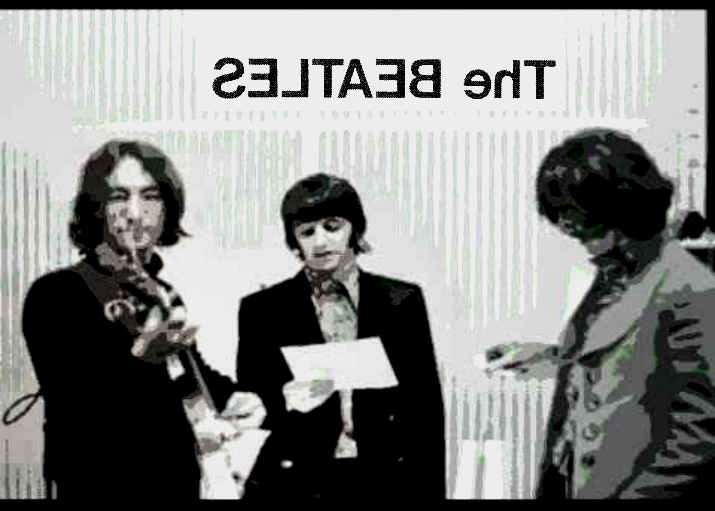
Well, it’s not really music, is it? It’s just all this baffling noise that keeps going on and on. But then Malcolm gets it. This is the one where it says Paul is dead, the secret track where all the Beatles mysteries are revealed. It has to be. So we listen again, louder, making sure we haven’t missed anything. Then a third time, VERY LOUD, which is when Mr. Walton, the Gym teacher, barges in, and asks us what the hell we’re doing. We never did finish that party tape. But I did get my tiny head turned around in a profound way – a question mark imposed upon all manner assumptions I had as to what music actually was. Or more to the point, at what point does noise become music? Or what happens when the two are indistinguishable? And who’s making the call? The secret, of course, is not to decide, just enjoy. Surf the chaos. See where it takes you. Thank you, Beatles. And Yoko, of course. No Yoko, no Revolution 9. No Beatles getting elevated to that level where they really were (still are) definitively, superlatively, eternally fab.” (Philip Random)

44-43-42. Trilogy – Daydream Nation

“Three in a row from Sonic Youth’s Daydream Nation, the suite known as Trilogy. Because it’s that kind of album. Crucial for both the culture as a whole (I think), and me in particular (I know). Because there it was, late 1988, the Winter of Hate, things having fallen apart (it’s a long story). I’m flat on my back on the bedroom floor, my parents place (another long story), so-called grown man doing yet another season in hell, recovering from various injuries and afflictions (self-inflicted and otherwise), too spent for anything but this prolonged commitment to nothingness … which could only be filled it seems by the sprawl of one monster of an album. Which was perfect really. If you’re only going to have just one album at the end of 1988, hard rains a-falling (metaphorically and otherwise), it may as well be the four sides of music and noise inseparable known as Daydream Nation, reminding you that the biggest truths have no boundaries, the most important stories never quite add up, the best songs never quite hold together, always yearning for, grasping for, gunning for MORE … and thus they are defined as much by the chaos at their edges as the calm at their centres (or is the other way around?).

The Trilogy from Side Four gets nod here, because it’s the final climax of an album that’s full of them. Guy wanders the sprawl, gets high, likely something psychedelic because he’s truly seeing the wonder in things (The Wonder), but then comes the long slow descent, the long walk home. He runs into some jocks, gets his shit kicked, ends up fading into nothingness (Hyperstation). And then who knows what happens? Except shit erupts. Like a god damned top alcohol dragster tearing up the quarter mile, fumes so intense they cause a rare local breed of starling to go extinct. (Eliminator Jr)  Life is a nuclear eruption. A chain reaction daydream that never ends. That’s my impression anyway. What’s yours?” (Philip Random)

47. I’m gonna booglarize you, baby

“In which the good Captain (Beefheart, that is) sublimely demonstrates what white men ought to be doing with the ole Mississippi Delta Blues – not just imitating them but working them, taking them somewhere deep, strange, more complicated, and yeah, probably inappropriate, because I don’t think booglarize just means to compel someone to get out on the dance floor. Though I did have the exquisite experience of watching a couple dance to it once, all wild hair and hippie beads. I was still just a kid really, maybe fourteen, hanging out at my friend Carl’s place during one his big brother’s parties. One of those legendary wild and wasted mid-70s affairs, before disco hit and confused everything in terms of what constituted suitable dance music. In fact, I’m pretty sure it’s first time I ever heard the Captain’s music. Paid attention to it anyway. But how could I not have noticed something like I’m Gonna Booglarize You, working at least three separate yet finely intertwined grooves with such finesse that a man couldn’t help but get to growling. Or a boy. Anybody really.”  (Philip Random)

(photo: Gijsbert Hanekroot)

53. oh yeah

“I doubt I’ll ever find the words for how wonderfully, ecstatically, profoundly the so-called Krautrock combo known as Can have affected me since I first crossed paths with them sometime around my twenty-fourth birthday. I guess I could write a book, but somebody already has. And anyway who’s got the time? But assuming I did, I suspect I’d give at least a chapter to that lamest of all Lollapaloozas. 1994, I think, Cloverdale BC, traffic jams, shitty food, too much sun, not enough water, too much dope, too many big deal bands not really delivering, failing to send me anywhere I hadn’t been before … except for maybe Nick Cave and the Bad Seeds until some loogan tossed a shoe at the stage. And that was that, early exit. F*** you, somebody.

And then, a few long hours later, it’s getting on sunset and I just want to cut my losses, go home, except I’ve lost touch with my ride, so whatever, I’m just sitting there alone in the middle of a very crowded field, waiting for the Beastie Boys who are up next, but I just saw them last year in a smaller, cooler, better situation, so no, I’m not feeling much in the way of excitement or anticipation. But then their pre-show DJ does a genius thing, drops the needle on Can’s Oh Yeah, from Tago Mago, certainly their biggest album … and it’s perfect, seven or so minutes of pulsing groove and eerie drones and backwards vocals and jagged rips of sideways guitar that somehow merges with the crowd noise and dust and fading light and redeems the f***ing the day, pulls all of its fragmented pieces together, makes it whole, worth all the trouble. Yeah, I could have just listened to the same record at home, sitting on the patio with a beer and a joint, but that would be like taking a helicopter to the peak of some notable mountain. Sometimes the trouble is the point, as I try to remind myself whenever shit keeps going sideways, going anywhere but where and how I want it. Such is life, I guess. If it was supposed to easy, they would have called it something else. And a song like Oh Yeah – it just wouldn’t matter as much.” (Philip Random)

61. desolation row

“It must’ve been early 1973 because I was still thirteen, working through the bullshit of Grade Eight, and everything else for that matter, including life itself, a big fat WHY BOTHER at the heart of pretty much all my musings. Because the Christian-God-based reality I’d had foisted on me from day one was too ridiculous to be taken remotely seriously. But what did that leave then other than meaninglessness, which was proving to be no fun at all. Meanwhile in the background, this Bob Dylan song was playing on the cool FM radio station of the moment (nobody else sounded like him, I had that much figured out) and it just kept going on and on, about postcards sent from hangings, and Cain and Abel, the Hunchback of Notre Dame, Insurance Men, the Titanic, Einstein disguised as Robin Hood, the Phantom of the Opera, Ezra Pound and T.S. Elliot … like the singer-poet-whatever in question had a damned serious message for me and he wasn’t going stop until I got it. Which I did finally. Except it wasn’t really a message. More of a feeling that I’d be wise to stop sweating the meaning stuff, and rather just get on with it, live, learn, encounter crazy shit, go to the hangings and bear witness, maybe drink cheap red wine, mix it up with marijuana, get serious about all that confusion out there (and within for that matter) not as an end but maybe as an indication that some higher wisdom-insight-glory might be waiting a little further down the line. And take notes, maybe send a few postcards of my own. Maybe this is one of them.” (Philip Random)

62. the golden void

“The first time I ever heard mention of Hawkwind, it was some punk rock loudmouth dismissing them as metal heads who’d fried their brains on too much brown acid. Which instantly sounded like something worth investigating. What they are, or certainly were (because it’s the deep weird 1970s, I’m thinking about here), was proper anarcho-hippie-revolutionaires who made the very best of their fabulously fried brains. Because it’s f***ing true, what the guy’s singing about in The Golden Void — the corridor of flame and the psychedelic warriors who commit to it, find themselves way the f*** out at the edge of time. Because I’ve seen them in my psychedelic journeys. Hell, I’ve been one, doing my infinitesimal bit to keep the universe expanding as it must, riding that big and glorious and infinite boom to its ever blooming edge. It’s all true. Trust me. I wouldn’t lie about something like that, and neither would Hawkwind. You can hear it in the passion of the performance, every means utilized to evoke what they’ve encountered: ever spiraling, never ending, indescribable, and the thing is, they’re still there, down the golden void, and so am I, surfing fractal edges of … eternity, I guess. Time and space are like that if you’re moving fast enough. I think. I wish I could somehow prove any of this. Which I suppose I can. But not if you won’t listen to stuff like The Golden Void at proper atom splitting volume … with the right kind of ears.” (Philip Random)